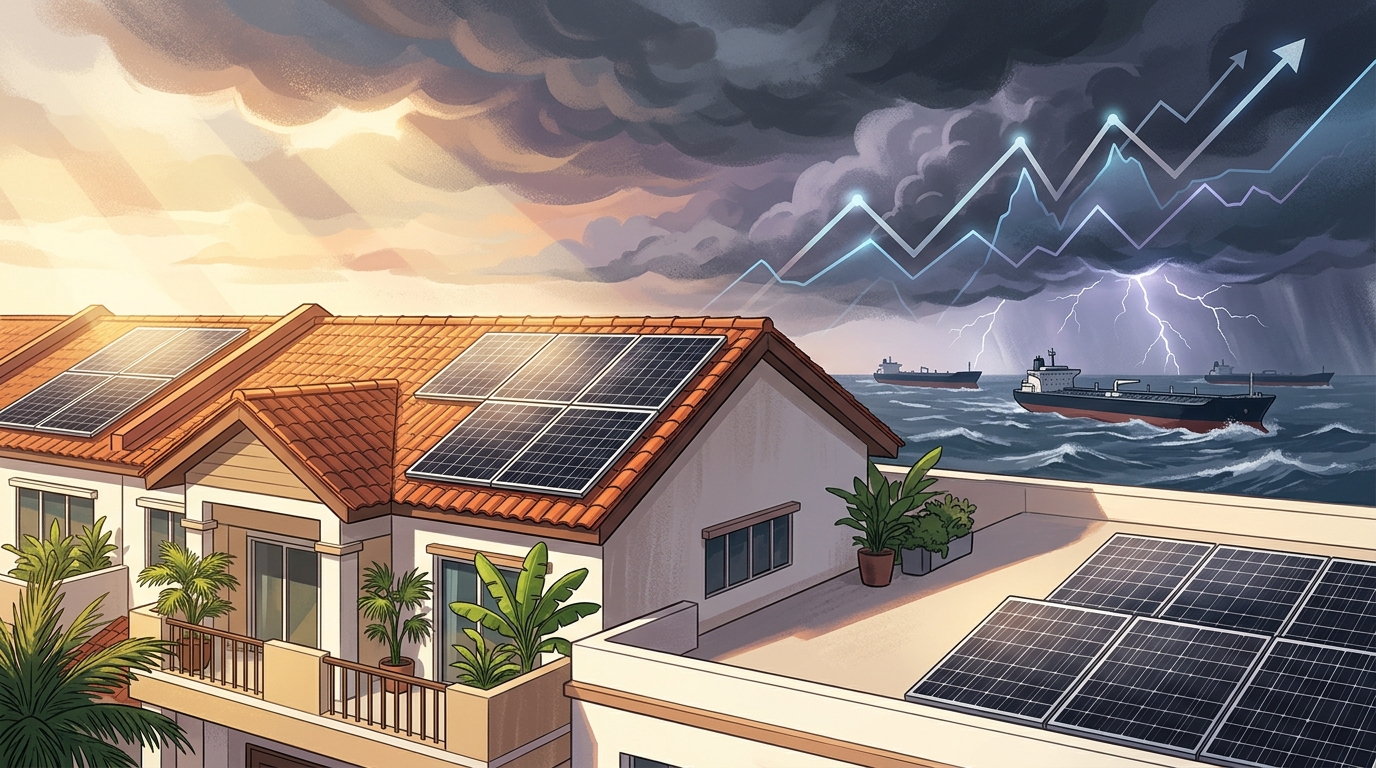
A War 6,000 km Away Is About to Hit Your TNB Bill
Since the US-Israel strikes on Iran began on 1 March 2026, global oil prices have surged sharply. Brent crude has topped $100 per barrel for the first time in years — and analysts warn it could climb much higher if the Strait of Hormuz remains effectively closed.
The Strait of Hormuz normally carries 20% of the world’s seaborne oil and gas. With Iran’s military disrupting traffic, roughly 20 million barrels per day of supply has been choked to a trickle. Gulf oil production has dropped by at least 10 million barrels per day.
What does this have to do with your electricity bill in Ipoh? Everything.
Malaysia’s Electricity Is Tied to Global Fuel Prices
Malaysia generates over half its electricity from coal and imported LNG — both commodities that are spiking due to the conflict. Under TNB’s Automatic Fuel Adjustment (AFA) mechanism, global fuel costs are passed through to your monthly bill.
Here’s the trend that should concern every homeowner:
| Month | AFA Rate (sen/kWh) | What It Means |
|---|---|---|
| Nov 2025 | -8.91 | Large rebate on your bill |
| Dec 2025 | -6.42 | Rebate shrinking |
| Jan 2026 | -4.99 | Shrinking further |
| Feb 2026 | -2.77 | Almost gone |
| Mar 2026 | -2.15 | Nearly zero |
The AFA rebate has dropped by 76% since its November peak. At this rate, it will flip into a surcharge — meaning you’ll pay more than the base tariff, not less. If you use more than 600 kWh/month, the AFA applies to your entire consumption.
Combined with the 13.6% base tariff increase that took effect in July 2025, Ipoh homeowners are facing the steepest electricity cost trajectory in a decade.
The Government Can’t Subsidise Forever
Malaysia is feeling the pressure on multiple fronts:
- The government’s fuel subsidy burden has grown significantly as the gap between market and subsidised prices widens
- RON97 petrol has hit RM4.55/litre; diesel has hit a record RM4.72/litre
- Over 60% of Malaysian exporters report negative impacts from the conflict
- Rising fuel costs are inflating the price of fertiliser, food packaging, and freight
The government has maintained the RON95 subsidy at RM1.99/litre for now, but analysts caution this is unsustainable. When fuel subsidies eventually crack, electricity subsidies typically follow.
Solar Panels: Your Hedge Against Energy Chaos
Unlike your TNB bill, solar energy costs nothing once installed. The sun doesn’t care about oil futures, geopolitical crises, or the Strait of Hormuz.
Here’s what solar looks like for a typical Ipoh home right now:
| Monthly TNB Bill | System Size | Estimated Cost | Annual Savings | Payback |
|---|---|---|---|---|
| RM150–250 | 4–5 kWp | RM15,000–22,000 | RM1,200–1,600 | 8–10 years |
| RM300–400 | 5–6 kWp | RM18,000–25,000 | RM3,000–4,000 | 5–7 years |
| RM400–600 | 7–9 kWp | RM26,000–38,000 | RM4,000–6,000 | 5–7 years |
And payback is accelerating. Every time the AFA rebate shrinks or tariffs rise, your savings from solar increase proportionally. A system that pays back in 7 years at today’s rates could pay back in 5 years if tariffs continue climbing.
Over 25 years, a typical Ipoh terrace house solar installation saves RM75,000 or more.
Three Reasons to Act Now, Not Later
1. Solar Panel Prices Are Rising
Solar module prices have already been rising, and starting April 2026, China is removing its VAT export rebate on solar modules — which will push prices even higher. Installing now locks in today’s lower costs.
2. Solar ATAP Has No Quota
Malaysia’s new Solar ATAP programme launched in January 2026 with no quota limits — unlike NEM 3.0 which was 99.8% full when it ended. But as demand surges, installer availability in Perak may become a bottleneck.
3. Zero-Upfront Options Exist
Rent-to-own solar plans start from RM248/month with zero downfront payment. In many cases, your monthly solar payment is less than the electricity savings from day one — meaning you save money from month one.
The Bottom Line
The Iran war has exposed a reality that many Malaysians haven’t fully considered: your electricity bill is directly tied to events you cannot control, happening in places thousands of kilometres away.
Solar panels give you something no TNB tariff plan can: energy independence. Your roof, your panels, your electricity — no matter what happens in the Strait of Hormuz.
With tariffs rising, rebates vanishing, and solar module prices climbing, the best time to install was yesterday. The second best time is now.
References
- Iran War Day 23 Updates — Al Jazeera
- Oil Tops $112 After Iraq Force Majeure — CNBC
- Strait of Hormuz Crisis — Dallas Fed
- Malaysia’s Unsubsidised Fuel Price Increase — The Star
- Malaysia Feels Heat as Conflict Lifts Costs — JPSFA
- TNB AFA Rate March 2026 — Paultan
- Global Oil Surge Could Raise Living Costs in Malaysia — RinggitPlus
- Solar Panel Cost Malaysia 2026 — GetSolar